An error occurred. Details Hide
You have unsaved pages. Restore Cancel

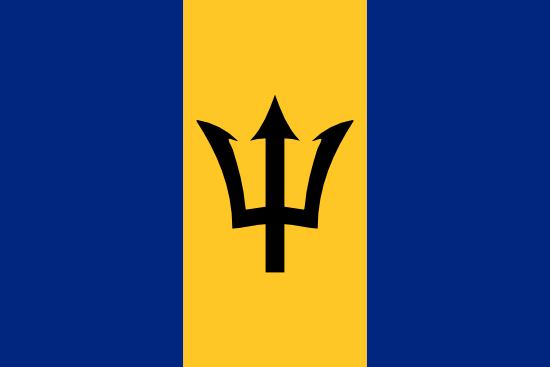
Barbados

  • Governor General:Dame Sandra Prunella Mason
  • Prime Minister:Mia Amor Mottley
  • Capital city:Bridgetown
  • Languages:English (official), Bajan (English-based creole language, widely spoken in informal settings)
  • Government
  • National statistics office
  • Population, persons:285,719 (2017)
  • Area, sq km:430 (2017)
  • GDP per capita, US$:16,789 (2017)
  • GDP, billion current US$:4.8 (2017)
  • GINI index:No data
  • Ease of Doing Business rank:132 (2017)
All datasets: M T
  • M
    • October 2016
      Source: World Bank
      Uploaded by: Knoema
      Accessed On: 17 November, 2016
      Select Dataset
      Relevant indicators drawn from the World Development Indicators, reorganized according to the goals and targets of the Millennium Development Goals (MDGs). The MDGs focus the efforts of the world community on achieving significant, measurable improvements in people's lives by the year 2015: they establish targets and yardsticks for measuring development results. Gender Parity Index (GPI)= Value of indicator for Girls/ Value of indicator for Boys. For e.g GPI=School enrolment for Girls/School enrolment for Boys. A value of less than one indicates differences in favor of boys, whereas a value near one (1) indicates that parity has been more or less achieved. The greater the deviation from 1 greater the disparity is.  
  • T
    • June 2015
      Source: Oxford Poverty & Human Development Initiative
      Uploaded by: Knoema
      Accessed On: 13 August, 2015
      Select Dataset
      The global Multidimensional Poverty Index (MPI) is an international measure of acute poverty covering over 100 developing countries. It complements traditional income-based poverty measures by capturing the severe deprivations that each person faces at the same time with respect to education, health and living standards. The MPI assesses poverty at the individual level. If someone is deprived in a third or more of ten (weighted) indicators (see left), the global index identifies them as ‘MPI poor’, and the extent – or intensity – of their poverty is measured by the number of deprivations they are experiencing. The MPI can be used to create a comprehensive picture of people living in poverty, and permits comparisons both across countries, regions and the world and within countries by ethnic group, urban/rural location, as well as other key household and community characteristics. This makes it invaluable as an analytical tool to identify the most vulnerable people – the poorest among the poor, revealing poverty patterns within countries and over time, enabling policy makers to target resources and design policies more effectively. The global MPI was developed by OPHI with the UN Development Programme (UNDP) for inclusion in UNDP’s flagship Human Development Report in 2010. It has been published in the HDR ever since.

Our Privacy Statement & Cookie Policy

Our website uses cookies to improve your online experience. They were placed on your computer when you launched this website. You can change your personal cookie settings through your internet browser settings.

Privacy Policy